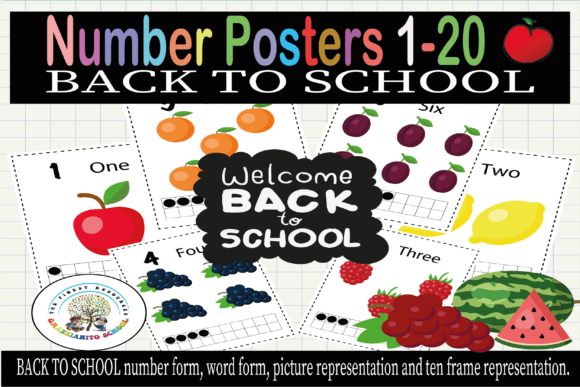
Number Posters 1-20 Pictures of Fruits
Number Posters 1-20 Pictures of Fruits is a classroom-ready visual resource designed to support early numeracy through real-world, sensory-rich imagery. Unlike cartoon-based or abstract number charts, this set uses high-resolution photographs of actual fruits—strawberries, bananas, grapes, oranges, apples, and more—to represent quantities from one to twenty. The result is a grounded, concrete connection between numeral, quantity, and familiar objects—making it especially effective for pre-K, kindergarten, and first-grade learners who benefit from tangible, contextual learning cues.
What Makes These Posters Stand Out in Practice
The core strength of Number Posters 1-20 Pictures of Fruits lies in its consistency and intentionality. Each poster displays a single numeral prominently, accompanied by exactly that many whole fruits arranged clearly and uncluttered. For example, the “7” poster shows seven plump blueberries spaced evenly; the “15” poster features fifteen sliced kiwi rounds in two neat rows. There’s no visual ambiguity—no overlapping fruit, no partial items, no decorative distractions. This clarity supports accurate one-to-one correspondence practice, a foundational skill for counting fluency.
Color fidelity and lighting are strong across all 20 posters. Fruits appear natural—not oversaturated or artificially lit—which helps avoid misrepresentation (e.g., a bruised banana isn’t used for “1,” nor are underripe limes substituted for “12”). That attention to realism matters: when students later handle real fruit during math centers or science discussions, the posters serve as reliable visual anchors—not stylized abstractions.
Design, Durability, and Classroom Integration
Each poster is sized for standard bulletin board use (typically 11" × 17" or A3), with ample white space around the central image and numeral. The typography is clean, sans-serif, and legible from across a room—no thin strokes or decorative fonts that sacrifice readability. While the files are digital (PDF or PNG), they print well on matte or semi-gloss cardstock, and laminating holds up over repeated handling and seasonal repositioning.
In daily use, these posters function flexibly. Teachers report using them not only for number recognition but also for launching discussions about classification (“Which fruits grow on trees? Which grow on vines?”), estimation (“How many seeds do you think are in this pomegranate?”), and even simple data collection (“Let’s tally how many classmates like apples vs. bananas”). Because the images are real, not illustrated, they cross over naturally into science units on plant parts, nutrition, or seasonal harvests—adding interdisciplinary value without extra prep.
Who Benefits Most—and Where It Fits Best
Educators working with English language learners (ELLs) find Number Posters 1-20 Pictures of Fruits particularly useful. The dual reinforcement—numeral + concrete referent + consistent vocabulary label (e.g., “12 lemons”)—supports both math and language development simultaneously. Similarly, special educators note improved engagement from students with attention challenges or visual processing differences: the photographic clarity reduces cognitive load compared to busy clip-art charts.
For homeschooling families or learning pods, the set works well as part of a rotating visual anchor system—swapping out posters weekly aligns with spiral review pacing. Small private schools and Montessori-aligned programs appreciate the absence of branding, characters, or narrative elements, allowing the materials to remain neutral and focused on concept mastery.
That said, it’s less suited for advanced learners beyond early elementary. There’s no embedded challenge extension—no skip-counting prompts, no comparison symbols, no place-value breakdowns. Its purpose is targeted: building number sense in the 1–20 range through consistent, realistic representation. If your goal is differentiation for mixed-grade groups or accelerated math pathways, you’ll need supplemental tools—but that’s by design, not deficiency.
Realistic Use Cases and Workflow Integration
A first-grade teacher in Portland shared how she uses the posters during morning meeting: each day, students gather near the current “number of the day” poster, count the fruit aloud together, then generate a related sentence (“There are 9 raspberries. Nine is one less than ten.”). Later, they replicate the quantity with manipulatives at their desks. Over time, students begin noticing patterns—how 16 strawberries form a 4×4 array, how 18 grapes can be grouped into threes—without explicit instruction. That organic pattern recognition emerges because the visuals invite closer looking.
Another practical application comes from a Title I school in Georgia, where teachers printed smaller versions (5" × 7") for student math toolkits. Paired with dry-erase markers, children circle groups, write equations, or label parts of the fruit—turning passive viewing into active interaction. The high-res source files allow this scaling without pixelation, adding versatility beyond wall display.
Limitations to Acknowledge Upfront
These are not interactive digital assets—there’s no audio, animation, or clickable functionality. They’re static printables, optimized for physical classroom environments. Also, while the fruit selection covers common varieties (apple, banana, orange, grape, strawberry, lemon, watermelon, etc.), it doesn’t include less familiar produce like dragon fruit or jackfruit—nor does it attempt cultural or regional representation (e.g., mangoes or lychees aren’t featured). That’s a reasonable constraint given the scope, but worth noting if your curriculum emphasizes global food systems or dietary diversity.
Finally, the set assumes basic printing access and minimal assembly (cutting, laminating, mounting). It’s not a plug-and-play kit with hooks or Velcro—but for most schools and home educators, that’s a negligible lift compared to the pedagogical return.
Long-Term Value and Teaching Alignment
When evaluated over a full academic year, Number Posters 1-20 Pictures of Fruits demonstrates strong retention of utility. Teachers reuse them across multiple cohorts—especially since the content doesn’t date or become culturally outdated. Unlike trend-driven themes (e.g., holiday-specific or character-based posters), these remain relevant year after year, supporting vertical alignment from August to June and across grade levels.
They align cleanly with NCTM’s early learning standards on counting and cardinality, as well as Common Core Math Standard K.CC.B.4–5. More importantly, they reflect evidence-informed practice: research consistently shows that linking numerals to authentic, high-fidelity images improves conceptual retention more than symbolic or fantastical representations alone.
If your priority is building durable number sense—not flash or novelty—Number Posters 1-20 Pictures of Fruits delivers measurable, repeatable value. It’s a quiet, dependable tool: not flashy, not over-engineered, but thoughtfully constructed for how young children actually learn. Used intentionally, it becomes part of the classroom’s cognitive infrastructure—supporting not just counting, but confidence, curiosity, and continuity.