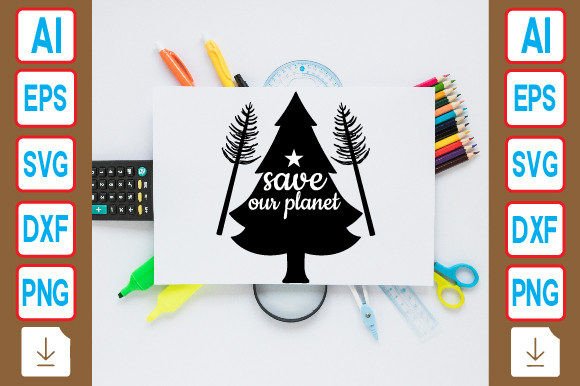
Save Our Planet: A Strategic Design Asset for Purpose-Driven Creators
“Save Our Planet” isn’t just a slogan—it’s a focused, values-aligned design motif with measurable utility across branding, education, advocacy, and product development. When delivered as a professionally crafted set of vector and raster files—including AI, SVG, DXF, EPS, and 300 DPI PNG with transparent background—it becomes more than decoration. It becomes infrastructure: reusable, scalable, production-ready visual equity you can deploy with intention.
Why This File Set Delivers Strategic Clarity—Not Just Convenience
Most digital design assets are either overly generic or narrowly styled. The Save Our Planet SVG cut file collection avoids both pitfalls. Its clean lines, balanced negative space, and adaptable composition allow it to function equally well on a classroom poster, a reusable tote bag, an eco-conscious Shopify banner, or a laser-cut wooden sign for a community garden. That versatility isn’t accidental—it reflects deliberate design thinking about context, audience, and output medium.
For educators building lesson plans around sustainability, the SVG and DXF files integrate seamlessly into Cricut or Silhouette software—letting students cut, layer, and assemble physical representations of environmental stewardship. For small business owners launching a zero-waste product line, the EPS and AI files provide print-ready scalability for packaging, labels, and trade show signage—no pixelation, no vendor delays, no licensing ambiguity.
When “Save Our Planet” Adds Real Value—and When It Doesn’t
Using this asset delivers ROI only when aligned with clear goals. Consider these high-leverage use cases:
- Brand Positioning: A wellness studio adding “Save Our Planet” to its reusable water bottle line signals shared values—not as an afterthought, but as part of its operational identity (e.g., compostable packaging + consistent visual language).
- Classroom Engagement: A middle school science teacher printing the PNG at 300 DPI for laminated station cards helps students connect abstract climate concepts to tangible actions—without needing design skills or budget for custom illustration.
- Community Campaigns: A neighborhood association laser-cutting the SVG file onto reclaimed wood for a local “Green Block Challenge” creates durable, photogenic touchpoints that reinforce collective agency—not just awareness.
Conversely, dropping “Save Our Planet” onto a generic email header without supporting content dilutes credibility. Visuals communicate fastest when they’re anchored in action. If your website features the graphic but lacks concrete steps—like a carbon footprint calculator, local volunteer calendar, or transparent supply chain report—the design becomes decorative, not directional.
How to Use These Files Intentionally—Not Automatically
Start with your objective—not the file. Ask: What outcome do I want this visual to support? Then match format to function:
- Use the SVG file for responsive web graphics—logos in navigation bars, animated icons in blog posts, or interactive infographics where crisp scaling matters across devices.
- Choose the DXF file for CNC routing, vinyl cutting, or embossing—especially when precision alignment or material thickness tolerance is critical (e.g., acrylic display stands or metal signage).
- Leverage the AI file to modify color palettes, isolate elements (like the globe or leaf motif), or combine with custom typography—ideal for creating branded slide decks or pitch materials where consistency builds trust.
- Rely on the PNG only when transparency and resolution are non-negotiable—such as overlaying the graphic onto photography in social ads or embedding in PDF reports where vector rendering may not be supported.
Avoid treating the EPS file as a “safe default.” While broadly compatible, EPS lacks modern transparency handling and color management. Reserve it for legacy print workflows—like older RIP software—or when explicitly requested by a commercial printer.
What to Consider Before You Download—and Deploy
This ZIP folder contains high-quality work—but quality alone doesn’t guarantee impact. Before integrating Save Our Planet, assess three dimensions:
- Alignment: Does this visual reinforce what your audience already believes—or does it risk feeling performative? A solar installation company using it on service vehicles reads as authentic; a fast-fashion retailer using it on discount banners reads as dissonant. Audit your messaging holistically.
- Execution Context: Will end users interact with it physically (e.g., cut vinyl on apparel) or digitally (e.g., animated SVG on a landing page)? Each demands different file choices, sizing rules, and accessibility considerations (e.g., sufficient contrast for screen readers).
- Long-Term Consistency: Can you sustain the message beyond the graphic? If “Save Our Planet” appears on your packaging, ensure your shipping materials, return policy, and vendor contracts reflect comparable environmental rigor. Visuals amplify systems—they don’t replace them.
Also note: While these files are royalty-free for your own use, they’re not licensed for resale as standalone digital products (e.g., uploading the SVG to a marketplace as your own design). They’re tools—not inventory.
Practical Planning Tips for Maximum Leverage
You’ve downloaded the files. Now what? Here’s how to move from possession to purpose:
- Batch-test variations before scaling. Try the SVG in two different brand color schemes on mockups—then ask three trusted colleagues which version better supports your core message. Don’t assume contrast or symbolism translates universally.
- Build a usage guide—not just a style guide. Document where each file type lives (e.g., “SVG = website icons; DXF = workshop materials; PNG = social media ads”) and name versions clearly (“SaveOurPlanet_GlobeOnly_SVG_v2”). Reduces decision fatigue and version confusion.
- Anchor it to behavior—not just aesthetics. Pair the graphic with a micro-commitment: “Scan to calculate your household’s annual plastic use” or “Click to join our quarterly park cleanup.” The visual opens attention; the action closes intent.
- Track downstream use—not just downloads. If you share these files with team members or contractors, note where they appear live (URLs, physical locations, campaign names). Patterns reveal what resonates—and what gets ignored.
The Risk of Misplaced Reliance
There’s real danger in treating Save Our Planet as a substitute for strategy. A beautifully cut vinyl decal on a delivery van means little if the fleet runs on diesel and lacks route optimization. A vibrant classroom poster loses power if curriculum standards don’t include climate literacy benchmarks. The file set enables execution—but only clarity of purpose determines whether that execution advances meaningful outcomes.
Worse, inconsistent or superficial use can trigger audience skepticism. Consumers and students alike recognize symbolic gestures versus systemic action. When “Save Our Planet” appears without evidence of follow-through—no progress metrics, no stakeholder input, no adaptation over time—it risks reinforcing cynicism, not connection.
Long-Term Value Lies in Integration, Not Isolation
The highest-return users of this Save Our Planet collection treat it as one node in a larger system: a visual thread connecting internal operations, external communication, and measurable impact. They update the PNG annually with new data points (e.g., “+12,400 trees planted since 2022”), re-export the SVG with adjusted stroke weights for improved legibility on mobile, or repurpose the AI layers into animated explainers for staff training.
That kind of sustained, adaptive use doesn’t happen by accident. It happens when creators start with questions like: What decisions will this graphic help clarify? Whose understanding will it deepen? What action will it make easier to take? Answer those first—and the files become instruments of influence, not just pixels and paths.
Because ultimately, “Save Our Planet” works best not as a statement—but as a scaffold for better decisions, clearer communication, and grounded action. And that starts long before you unzip the folder.