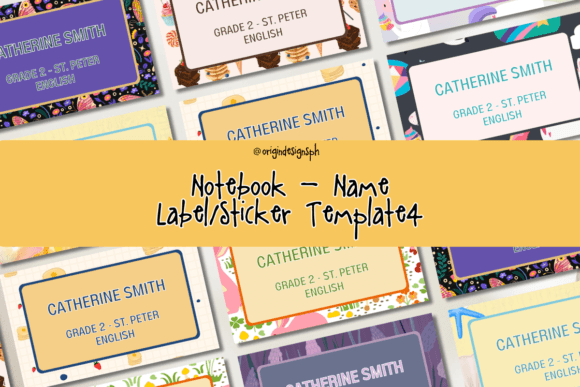
Notebook Name Label Sticker4
Back-to-school season is more than just new supplies—it’s a fresh start, a chance to organize with intention, and an opportunity to infuse everyday learning tools with personality and clarity. That’s where Notebook Name Label Sticker4 steps in: a clean, minimalist, and highly functional set of editable label templates designed for real-world use—not just aesthetics.
Each template measures precisely 5 x 3 inches, fitting seamlessly on standard notebooks, composition books, textbooks, binders, and even library-style book spines. The layout balances visual breathing room with practical legibility—no cramped fonts, no overwhelming graphics. Just thoughtful design that supports function first.
Why These Labels Stand Out (Beyond the Obvious)
It’s not just about labeling—it’s about consistency, ownership, and ease. Students lose track of materials when names are handwritten faintly or stuck crookedly. Teachers juggle dozens of notebooks weekly and need instant visual recognition. Homeschooling parents want systems that scale across ages and subjects. Notebook Name Label Sticker4 answers all three by offering uniformity without rigidity.
The 10 included designs vary in tone—not just color or font, but structure. Some prioritize bold name fields with subtle decorative accents; others feature dual-line layouts ideal for grade level + subject (e.g., “Maya Chen • Grade 5 Science”). One design uses a soft border motif that works equally well for kindergarten journals and high school lab notebooks. This range means you’re not choosing *a look*—you’re selecting the right tool for a specific context.
Creative Uses Beyond the Classroom
While built with school in mind, these labels thrive in unexpected places:
- Small business inventory: Label sample notebooks, client binders, or training manuals with consistent branding—even if your logo isn’t printed, the typography and spacing reinforce professionalism.
- Library or co-op lending systems: Use one design for borrower names, another for due dates or category codes—print batches ahead of time and handwrite updates only when needed.
- Homeschool portfolio tracking: Assign each child a signature color scheme across all their materials, then use matching stickers on notebooks, flashcards, and assessment folders.
- Teacher resource kits: Bundle printed labels with lesson plans or classroom management guides—your buyers get ready-to-use organization, not just theory.
No design overhaul required. Because everything lives inside Canva, swapping colors, adjusting text size, or adding a short tagline (“Room 204 • Fall 2024”) takes seconds—not hours.
How Different Users Can Adapt Them Purposefully
Educators can batch-edit one template for an entire grade level, then export individual PDFs per student—no copy-paste errors, no mismatched fonts. Pair it with a simple spreadsheet to auto-populate names before printing.
Freelance designers and creators use the templates as a starting point—not an endpoint. Add your own icon set, integrate brand-aligned Pantone swatches, or create seasonal variants (back-to-school, holiday review, end-of-year reflection) using the same base grid. Since you’re allowed to sell printed copies, these become low-overhead physical products for Etsy, local markets, or school PTA fundraisers.
Bloggers and curriculum developers embed printable versions directly into paid resource bundles. A single Canva link lets customers personalize before downloading—increasing perceived value while reducing your support load.
Hobbyists and organizers appreciate the restraint: no clipart overload, no forced cutesiness. You control tone—swap a playful script font for something geometric and modern, or add a thin rule line beneath the name for subtle hierarchy. It stays useful whether your aesthetic is Scandinavian minimalism or warm analog nostalgia.
Practical Tips for Best Results
Start simple. Open the Canva template, type one name, print a test sheet on plain paper, and hold it against a real notebook. Check alignment, contrast, and readability at arm’s length—not just on screen. Adjust font weight before scaling down; light fonts often vanish when printed small.
If selling printed versions, invest in matte sticker paper (not glossy)—it resists smudging from backpack friction and eraser rubs. For bulk orders, group labels by design rather than student name to minimize Canva tab-switching and printer refeeds.
Keep version control lightweight: rename your Canva files clearly (“Sticker4-Science-Grade5-v2”), and save final PDFs with embedded fonts. That way, if you revisit the project months later—or share it with a colleague—you won’t face missing glyph errors or layout shifts.
What Respectful Use Looks Like
You’re free to edit, print, and distribute physical copies—whether for your own kids, your students, or your customers. You can even bundle them into larger product offerings (e.g., “Back-to-School Starter Kit” including planners, checklists, and these labels). But you may not resell the Canva file itself, share editable links publicly, or upload the template to design marketplaces as a digital download.
This balance protects both the creator’s work and your integrity as a user. It encourages thoughtful adaptation—not replication. When you tweak spacing to fit a narrow journal spine, or choose a muted palette for dyslexia-friendly contrast, you’re adding value. That’s the kind of creativity search engines—and real people—recognize.
Getting Started Is Lighter Than You Think
You don’t need design experience. You don’t need expensive software. You do need clarity about your goal: Is this for one child’s third-grade year? A tutoring service’s branded student kits? A boutique stationery shop launching a back-to-school collection?
Once that’s clear, open the Notebook Name Label Sticker4 template, pick the design closest to your intent, swap the placeholder text, adjust sizing if needed, and hit print. From idea to applied tool: under five minutes.
And because it’s built for reuse—not one-off perfection—you’ll find yourself returning to it again: for summer camp notebooks, volunteer training binders, or even labeling pantry jars in your home office. Good design doesn’t shout. It serves, adapts, and stays quietly reliable—just like these labels.