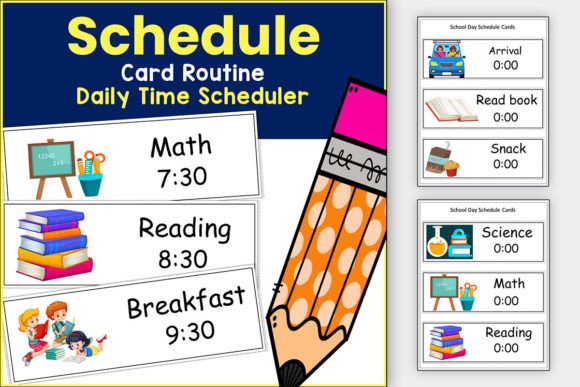
Editable Visual Classroom Schedule Cards
Creating a predictable, calm, and purposeful classroom environment starts with clarity—and nothing delivers clarity like a well-designed visual schedule. Editable Visual Classroom Schedule Cards are more than just classroom decor; they’re a practical, research-informed tool that supports executive functioning, reduces transition anxiety, and builds student independence—especially for learners who thrive with structure, including those with autism, ADHD, or language-based learning differences.
Teachers and homeschooling parents consistently face the same core challenges: managing time across a dynamic school day, supporting students who struggle with sequencing or time awareness, and adapting routines without reinventing the wheel each week. A rigid, one-size-fits-all schedule rarely survives the reality of fire drills, assemblies, guest speakers, or spontaneous teachable moments. That’s where flexibility meets intention—and why Editable Visual Classroom Schedule Cards stand out as a responsive, sustainable solution.
Why Structure Matters—And Why It Must Be Adjustable
Visual schedules aren’t just helpful—they’re foundational. Research shows that consistent, visible routines improve on-task behavior, decrease off-task interruptions, and strengthen students’ ability to anticipate what comes next. But “consistency” doesn’t mean inflexibility. In fact, the most effective schedules are *easily updated*, so students remain oriented even when the day shifts. Without editable components, teachers often resort to handwritten whiteboard notes or laminated cards they can’t revise—leading to cognitive dissonance (“Wait, is math *really* at 10:30 today?”) and lost instructional time spent re-explaining changes.
Editable Visual Classroom Schedule Cards solve this by putting control in your hands—not just once, but every single day. Whether you're adjusting for a shortened period, accommodating a therapy session, or rotating centers mid-week, you can update times, labels, or both in minutes—no design skills required.
What’s Included—and How Each Version Fits Real-Classroom Needs
The resource includes five intentional formats, each designed for a specific implementation style:
- Print and Write Daily Schedule Cards: Ideal for teachers who prefer handwriting or want students to co-create the schedule. These come with non-editable headings (e.g., “Morning Meeting,” “Reading Workshop”)—just print, write in your times, and laminate for durability. Great for early elementary or special education settings where consistent vocabulary matters most.
- Cards with Editable Times Only: Use the included PowerPoint file to type in start/end times only—keeping your established activity labels intact. Perfect for upper elementary or middle school teachers who maintain the same block structure but adjust timing weekly.
- Cards with Editable Headings and Times: Full customization. Change both activity names *and* times—and choose any font, color, or layout that aligns with your classroom theme or accessibility needs (e.g., dyslexia-friendly fonts, high-contrast text). This version empowers teachers to reflect unique curricula, project-based units, or inclusive naming conventions (“Quiet Reading” instead of “Sustained Silent Reading”).
- Blank Clocks: Pair these with your schedule cards to reinforce analog time literacy. Students can draw or place movable clock hands beside each activity—turning time management into an active, tactile skill.
- Heading Card: Available in both printable and editable formats, this serves as your schedule’s anchor—labeling it “Today’s Schedule,” “Our Daily Flow,” or “My Learning Plan” depending on your audience and goals.
Real-World Applications Across Learning Environments
In a busy kindergarten classroom, a teacher uses the Print and Write cards every morning during circle time—inviting students to help fill in the clock times. The ritual builds ownership and reinforces number sense. Later, she swaps in an Editable Heading + Time card for a special science fair week, renaming “Writing Workshop” to “Science Journaling” and adjusting durations to accommodate lab rotations.
A special education co-teacher relies on the Editable Times Only version to align her small-group schedule with the general education teacher’s pacing—without having to recreate the entire visual system. Meanwhile, a homeschool parent uses the blank clocks alongside editable headings to support her child’s self-directed afternoon routine, adding icons for breaks, movement, and snack.
Even in secondary settings, these cards scale meaningfully: a middle school counselor uses them to structure social-emotional learning blocks, while a high school inclusion teacher adapts headings for “Independent Work,” “Peer Collaboration,” and “Teacher Check-In”—helping students navigate shifting expectations across classes.
Implementation Tips for Maximum Impact
Start simple. Choose one format—like the Print and Write cards—and use them for three core parts of your day (e.g., Morning Meeting, Literacy, Math). Observe how students respond. Do they reference the schedule independently? Do transitions feel smoother? Once that rhythm is established, layer in editable versions to increase responsiveness.
Laminate thoughtfully: Use matte laminate to reduce glare, and pair cards with Velcro dots or magnetic strips for easy rearranging. Place the schedule at student eye level—and consider adding a “Now/Next” strip for students who benefit from immediate focus.
Don’t overlook the power of routine *around* the schedule itself. Spend 2–3 minutes each morning reviewing the day together—pointing to times, modeling how to read the clock cards, and inviting questions. Over time, this builds metacognitive awareness: “I know math ends when the big hand is on the 12—that means it’s time for recess.”
More Than Decor—A Tool for Equity and Access
Classroom visuals are never neutral. When schedules are static, unclear, or overly text-dense, they unintentionally exclude students who are emergent readers, dual-language learners, or neurodivergent. Editable Visual Classroom Schedule Cards support universal design because they let you tailor not just content—but clarity, language, pacing, and representation.
You decide whether “Specials” becomes “Art,” “Music,” or “PE”—or whether “Snack” appears as a word, icon, photo, or both. You choose contrast, spacing, and font size to meet IEP accommodations or school-wide accessibility guidelines. And because everything is printable and reusable, there’s no ongoing cost—just consistent, compassionate structure.
As Back to School approaches—or anytime you’re refining your classroom systems—investing in Editable Visual Classroom Schedule Cards isn’t about buying another resource. It’s about choosing sustainability over scramble, clarity over confusion, and student agency over passive compliance. With thoughtful implementation, these cards become less of a “tool” and more of a quiet, steady presence—one that says, clearly and kindly: You know what’s coming. You belong here. You can do this.